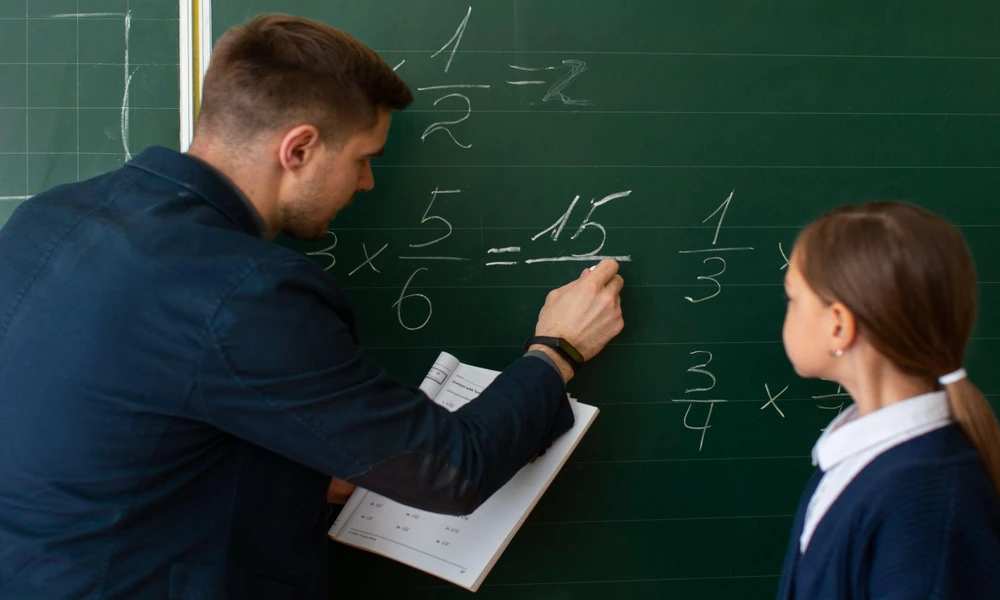
Learning mathematics involves more than reaching the correct answer. Students also need to understand why a method works, recognise when it is appropriate, and determine how to approach questions that do not immediately resemble examples they have seen before.
This distinction separates explaining a maths solution from teaching problem-solving. A maths tuition teacher in Singapore, for example, may demonstrate a procedure to introduce a concept before asking students to apply that knowledge independently to other problems.
Both approaches have a place in mathematics education. Understanding how they differ helps clarify why students may be able to follow a worked solution yet still find independent problem-solving difficult.
What Does It Mean to Explain a Maths Solution?
Explaining a solution generally involves showing how to move from a question to an answer. The teacher may demonstrate a sequence of calculations while explaining the mathematical principles or rules involved.
A clear explanation can help students understand:
- what information the question provides;
- which mathematical concept or formula is relevant;
- how each step follows from the previous one;
- why a particular operation or method is used; and
- how the final answer can be checked.
Worked examples are commonly used when introducing procedures or demonstrating how existing knowledge can be applied. Research in cognitive science has found that worked examples can be particularly useful during the early stages of learning because students can focus on understanding the procedure rather than simultaneously searching for a solution.
However, being able to follow an explanation does not necessarily demonstrate independent problem-solving ability. A student may understand each displayed step but still be unsure about which strategy to choose when the method is not provided.
Therefore, solution explanations can establish knowledge of methods, while further practice is needed to develop independent application.
What Does Teaching Maths Problem-Solving Involve?
Problem-solving places greater emphasis on the decisions students make before and during the solution process. Rather than simply reproducing a demonstrated method, students must interpret the problem and determine an appropriate approach.
Depending on the question, this can involve:
- identifying relevant and irrelevant information;
- connecting the problem to previously learned concepts;
- selecting a suitable strategy;
- breaking a complex problem into smaller parts;
- monitoring whether the chosen approach is working; and
- checking whether the final answer is reasonable.
The distinction can be summarised as follows:
| Area | Explaining a Solution | Teaching Problem-Solving |
| Main focus | Understanding a demonstrated method | Choosing and applying strategies |
| Teacher role | Models and explains steps | Guides reasoning and provides feedback |
| Student activity | Follows and interprets a method | Analyses, selects and tests approaches |
| Typical outcome | Understanding how a problem was solved | Greater ability to approach new problems |
Teachers can support problem-solving by asking students to explain their reasoning rather than only giving an answer. Questions such as “Why did you choose this method?” or “Is there another way to solve this?” encourage students to examine the reasoning behind their approach.
A maths tuition teacher in Singapore may also use guided practice, initially providing prompts before gradually reducing assistance. This shifts responsibility for selecting and applying methods towards the student.
In summary, problem-solving instruction focuses not only on obtaining an answer but also on developing the reasoning needed to decide how that answer can be reached.
Why Do Students Need Both Worked Solutions and Problem-Solving Practice?
Worked solutions and problem-solving practice serve different but complementary purposes. Students first need sufficient knowledge of mathematical concepts and procedures before they can apply them effectively across different situations.
Worked examples can provide a structured model of how mathematical knowledge is applied. Guided questions can then require students to complete some steps independently before progressing to problems where they must select the entire approach themselves.
A gradual progression may involve:
- studying a fully worked example;
- explaining why individual steps are necessary;
- completing partially worked problems;
- solving similar questions independently; and
- applying the concept to less familiar problems.
Problem-solving practice also gives teachers information about what students understand. Errors may reveal difficulties with calculation, conceptual understanding, interpreting questions, or choosing strategies.
The two approaches therefore do not need to compete. Explanation can establish and clarify mathematical methods, while problem-solving practice develops the ability to select, adapt, and apply those methods independently.
FAQs
Is problem-solving the same as practising maths questions?
Not necessarily. Repeatedly completing questions using the same known procedure can strengthen fluency, while problem-solving often requires students to determine which concepts or strategies are appropriate.
Why can a student understand a worked solution but struggle with a new question?
Following a worked example provides the method in advance. A new question may require the student to recognise the underlying mathematical structure and select an appropriate method without that guidance.
Are worked examples useful for learning maths?
Yes. Research supports the use of worked examples, particularly for learners who are developing knowledge of a new procedure or concept. Their usefulness depends partly on how examples are explained and integrated with practice.
Can mathematical problem-solving be taught?
Problem-solving can be developed through instruction and practice. Teachers can model reasoning, ask guiding questions, compare alternative approaches, provide feedback, and gradually reduce support as students gain competence.
Why are both explanation and independent practice important?
Explanation helps students understand mathematical concepts and procedures, while independent practice provides opportunities to retrieve, select, and apply that knowledge. Combining the two supports progression from guided learning towards more independent mathematical reasoning.
Visit Sirius Mathematics and let us help you develop mathematical reasoning across different types of questions.
